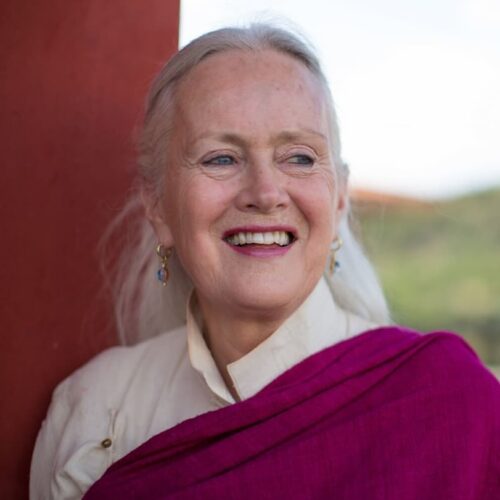
Lama Tsultrim Allione is a world-renowned Buddhist teacher, lineage holder, and author whose life’s work has helped bring the heart of Tibetan Buddhism, and especially the sacred feminine and the lives of women practitioners, into the lives of thousands of people around the world. She is the author of three books and founder of Tara Mandala, a 700-acre Buddhist retreat center in the San Juan Mountains of Southwest Colorado. At Tara Mandala she created a living mandala where ancient wisdom, contemporary psychology, and visionary ritual practice meet in an embodied way.
At a Glance
- Founder and spiritual director of Tara Mandala, an international Buddhist community and retreat center in Pagosa Springs, Colorado

- Recognized as an emanation of the 11th-century yogini Machig Labdrön
- First American woman ordained as a Tibetan Buddhist nun in 1970 in the Karma Kagyu lineage
- One of the first Western teachers authorized by both Chögyam Trungpa Rinpoche and Chögyal Namkhai Norbu Rinpoche
- Bestselling author of Women of Wisdom, Feeding Your Demons, and Wisdom Rising: Journey into the Mandala of the Empowered Feminine
- Mother of three and grandmother of six

Early Life and First Encounters with Buddhism
Lama Tsultrim was born Joan Rousmanière Ewing on October 3, 1947, in Bangor, Maine, into a family steeped in public service and philosophical inquiry. Her father, James D. Ewing, was a New England newspaper publisher; her mother, Ruth D. Ewing, worked as a labor mediator and community mental health advocate. On her mother’s side, both grandparents earned doctorates in philosophy at Harvard, with her grandmother, Frances R. Dewing, among the first women to receive a Harvard-Radcliffe PhD before teaching at Mount Holyoke and Smith Colleges. Her paternal grandfather, Oscar R. Ewing, served in President Harry Truman’s cabinet, . and the key policy strategist behind what eventually became Medicare and Medicaid
Growing up with her older sister, Carolyn, and younger brother, Thomas, she spent much of her youth on horseback and skis. Competitive riding, downhill ski racing, and a love of the wild cultivated the physical courage and intimacy with nature that would later echo in her vision of a mountain retreat center . At 15, her grandmother Frances quietly shifted the course of her life by giving her a book on Buddhism, opening a world centered on meditation and liberation. A year later, in Cambridge Mass., she picked up Carl
Jung’s Man and His Symbols and was struck by the Tibetan mandala on the cover, a circular image of wholeness that would become a lifelong symbol of spiritual unfolding. .
In 1965, she enrolled at the University of Colorado in Boulder and found her first book on yoga in the university library. The more she read, the clearer it became that the teachings she longed for were not being taught in universities and . by 1967, at 19, she set out for Nepal and India hoping to learn to paint mandalas, not yet knowing she was stepping into a lifetime of immersion in Tibetan Buddhism.
Journey to India and Ordination as a Buddhist Nun
In Kathmandu, living among Tibetan refugees near the Swayambhu stupa, she felt an immediate, visceral sense of “arriving home.” Each morning she slipped into a Kagyu monastery and sat quietly while the rituals unfolded, absorbing the cadence of chants, gestures of devotion, and the feeling of a space saturated with practice. During this time she lived with American yogi Bhagavan Das and psychologist Richard Alpert (later Ram Dass), who were themselves in the midst of a now-legendary spiritual journey.
When Bhagavan Das and Alpert left to meet the Hindu guru Neem Karoli Baba, she chose a different path and began hitch-hiking across Northern India to Dharamsala, determined to meet His Holiness the Dalai Lama. That journey marked the beginning of a lifelong engagement with Tibetan Buddhism, in which philosophical teachings, meditation, and compassionate action were inseparably intertwined.

In Kathmandu, living among Tibetan refugees near the Swayambhu stupa, she felt an immediate, visceral sense of “arriving home.” Each morning she slipped into a Kagyu monastery and sat quietly while the rituals unfolded, absorbing the cadence of chants, gestures of devotion, and the feeling of a space saturated with practice. During this time she lived with American yogi Bhagavan Das and psychologist Richard Alpert (later Ram Dass), who were themselves in the midst of a now-legendary spiritual journey.
When Bhagavan Das and Alpert left to meet the Hindu guru Neem Karoli Baba, she chose a different path and began hitch-hiking across Northern India to Dharamsala, determined to meet His Holiness the Dalai Lama. That journey marked the beginning of a lifelong engagement with Tibetan Buddhism, in which philosophical teachings, meditation, and compassionate action were inseparably intertwined.
Lama Tsultrim returns to Manali to be with Apho Rinpoche and learns her first Chöd practice of Naro Sang Chöd from Gegyen KhyentseIntensive Study, Practice, and Return to the West
After ordination, her life became a tapestry of intensive study and retreat across India and Nepal. She practiced under teachers such as Sapchu Rinpoche, Lama Thupten Yeshe, and Lama Zopa Rinpoche, grounding herself in both philosophy and meditation. In 1971 she traveled to Darjeeling to receive Ngöndro (preliminary practices) and Chenrezig from Kyabje Kalu Rinpoche, planting her firmly in the Karma Kagyu retreat culture.
Her path carried her back to Bodhgaya, where she reconnected with Ram Dass and early Western students at some of the first Vipassana courses led by S. N. Goenka. She immersed herself in Buddhist philosophy in Sarnath and, in the Himalayas, met H.E. Khamtrul Rinpoche before continuing on to Manali, where she encountered her heart teacher, Apho Rinpoche, grandson of the great yogi Shakya Shri.
Returning to the United States in late 1972, at 25, she went straight into retreat at Trungpa Rinpoche’s center, Tail of the Tiger (now Karmê Chöling), and completed her Ngöndro there. Those months also brought her into contact with poet Allen Ginsberg; traveling with him, and later with Ginsberg and Ram Dass in the American West, she saw how Tibetan Dharma, Beat poetry, and the counterculture could speak to one another.
After a year back in the US, Trungpa Rinpoche sent her again to India as his emissary to invite the 16th Karmapa to America. During this period she received the Dam Ngag Dzod empowerments from Dilgo Khyentse Rinpoche in a three-month transmission, saturating her in the non-sectarian Rimé tradition. Returning once more to Manali, she deepened her Shakya Shri lineage practice with Apho Rinpoche, including Naro Sang Chöd.
Over time she felt a quiet but insistent knowing that her path also needed to include marriage and family. With deep respect, she chose to return her monastic vows. Shortly after disrobing, she married Dutch student Paul Kloppenburg in Delhi, and together they moved to Vashon Island off the coast of Washington State, carrying the Dharma into the equally demanding arena of household life.
Marriage, Motherhood, and Early Teaching
Life on Vashon Island brought new teachers and responsibilities. She and her husband studied with Dezhung Rinpoche even as she entered the rhythms of motherhood. She gave birth to her daughters, Sherab and Aloka, and learned what it meant to practice in the midst of diapers, meals, and interrupted sleep. The image of a yogini in a mountain cave now alternated with that of a mother in the kitchen, but the thread of practice remained continuous.
The family later moved to Boulder, Colorado, to continue studying with Chögyam Trungpa Rinpoche. There, her marriage to Paul ended and a


new phase of her vocation began. Trungpa trained her as one of his first Western meditation instructors and invited her to teach widely. She began offering meditation instruction at Naropa Institute (now Naropa University) and worked within Vajradhatu (now Shambhala International), eventually receiving Vajra Varahi empowerment and authorization as a Vajrayana meditation instructor.
In 1978, while at Naropa, she met Italian filmmaker Costanzo Allione and eventually moved with her daughters to Italy. There she encountered Chögyal Namkhai Norbu Rinpoche, a great Dzogchen master and scholar, and entered into what would become an 18-year period of study and practice under his guidance. In 1980 she gave birth to twins, a boy named Costanzo and a girl named Chiara.
When Chiara died from Sudden Infant Death Syndrome at two and a
half months old, it shattered her heart and opened a burning question: where were the stories of women who had walked the path through loss, love, and realization. Her grief became a vow to uncover the hidden lives of great women practitioners. That vow ripened into Women of Wisdom, published in 1984, which brought forward the biographies of six Tibetan female masters alongside a deeply personal autobiographical preface.
Returning to the United States, she completed a master’s degree in Buddhist Studies/Women’s Studies at Antioch University and continued to teach under Namkhai Norbu’s auspices. After the end of her second marriage, she taught widely across North America and Europe. In 1988 she met her third husband, David Petit, a dance and theater teacher at a Waldorf school in New York. Their marriage became a creative and spiritual partnership that would eventually find its home on a piece of land in Southwest Colorado.
Vision and Founding of Tara Mandala
In 1993, with her children grown and decades of practice behind her, a vision that had first appeared in Manali twenty years earlier came into full focus. She saw a Western retreat center where practitioners could enter deep, sustained retreat as they had in Tibet, yet held within a context that honored Western psychology, the sacred feminine, and the specific karmic patterns of modern life.
That vision led her and David to the San Juan Mountains of Southwest Colorado. In September 1993 they found 700 acres of rolling hills,

Photo credit: Josh Brownleeflowering meadows, and forests that felt unmistakably like a living mandala. Standing on that land, surrounded by sky and peaks, she recognized the place she had been seeing in dreams and meditation. They named it Tara Mandala, dedicating it to Tara and to the mandala principle of awakened wholeness.
The early years at Tara Mandala were raw and simple. A small community moved onto the land and began holding retreats in large tents and yurts. Cabins slowly appeared. Visiting teachers offered teachings and empowerments. Daily life involved cooking, digging, building, practicing, and sitting under vast night skies. The retreat culture she had experienced in the Himalayas began to take root in the high desert of Colorado.
In 1999, Chögyal Namkhai Norbu Rinpoche consecrated the first stupa on the land, dedicated to Nyala Pema Duddul, a great Dzogchen master who attained rainbow body in 1872. Between 2005 and 2008, three major buildings were completed: the Community Building (kitchen, dining, offices, store, bathing facilities); the Prajna Residence Hall (housing for about forty retreatants); and the three-story, mandala-shaped Trikaya Tara Temple, the only Tara temple of its kind in the West. Tara Mandala also became home to Tara’s Pure Land, a rare open-air cremation grounds and Zhitro temple dedicated to death, transition, and the 100 peaceful and wrathful deities. What began as a vision in a Himalayan valley matured into an international sangha with more than forty practice groups and affiliated centers.
Machig Labdrön, Chöd, and Sacred Feminine Lineage
From the moment she first learned Chöd from Gegyen Khyentse in 1972, Machig Labdrön’s lineage has been the luminous thread through her life. Chöd – “cutting through” – arises from Bön ritual and the Prajñaparamita teachings; it asks practitioners to offer their own body as a feast to demons and obstructive forces, cutting the root of self-clinging through radical generosity and fearlessness.
In 1981, while practicing Chöd with Namkhai Norbu Rinpoche, she had a vivid vision of Machig that changed everything. That vision led her to discover and translate Machig’s biography and to include it in Women of Wisdom, giving Western readers one of the first accessible windows

into this 11th-century yogini’s life and realization. Over the years, Machig’s lineage moved from being one thread among many to the central pattern of her teaching.
While teaching Chöd, she noticed how readily Western students personified and dialogued with their inner obstacles. Out of that observation grew Feeding Your Demons, a five-step process that adapts Chöd into a psychologically attuned method for working with inner and outer “demons” – grief, addiction, trauma, destructive patterns – by feeding and listening to them rather than fighting or repressing them. Her book Feeding Your Demons: Ancient Wisdom for Resolving Inner Conflict articulated this method for a broad audience and was later named one of the Best Spiritual Books of 2008. From there she developed Kapala Training, a structured, multi-year path that combines Feeding Your Demons with other practices from Machig’s lineage for students around the world.
In 2007, while leading a pilgrimage to Tibet, external signs of this connection flowered in striking ways. At Zangri Khangmar, Machig’s monastery, the resident lama had dreamt of a white dakini coming from the West, sounding a damaru. When the group arrived, rainbows and long-awaited rain appeared. Lama Karma Dorje Rinpoche recognized her as an emanation of Machig Labdrön and entrusted Machig’s relics to her to be brought back to Tara Mandala, declaring that the future of Machig’s lineage lay in the West.
Soon after, in Nepal, Lama Tsering Wangdu, a lineage holder of Machig’s Chöd, shared that he too had dreamt of Machig and her lineage descending from the sky. During a Machig Chöd empowerment, he saw Machig dissolve into Lama Tsultrim’s heart. Later he traveled to Tara Mandala, formally recognized her as an emanation of Machig Labdrön, bestowed the title “Lama,” and composed a long life prayer and praises. In 2012, His Holiness the 17th Karmapa conferred the Machig Labdrön empowerment on her, further sealing this sacred feminine lineage.

Loss, Pilgrimage, and Return
On July 22, 2010, her husband and partner in Tara Mandala, David Petit, died suddenly of a heart attack. He was cremated on the land, in front of the stupa he had built, in a ceremony marked by vivid natural signs that many lamas later described as indications of realization. For forty-nine days after his passing, traditional practices were performed both at Tara Mandala and at Adzom Rinpoche’s monastery in Tibet; David’s tögal teacher, Tsoknyi Rinpoche, traveled to Tara Mandala to perform the forty-ninth-day ceremony. His ashes were mixed with clay and made into tsatsas placed in a small tsakang on a ridge where he had practiced at dawn, letting his body literally become part of the mandala.
In the wake of this loss, Lama Tsultrim undertook a long pilgrimage through Asia. She received the entrustment and oral transmission of the Dzinpa Rangdröl cycle from Do Dasel Wangmo in Kangding, visited Machig Labdrön’s cave and birthplace in central Tibet, and reconnected with the 17th Karmapa and Sey Rinpoche in Nepal and India. She then traveled to Australia to see Namkhai Norbu Rinpoche, weaving together pilgrimage, grief, and a renewed commitment to her life’s work.
By the end of 2011 she returned to public teaching, offering Chöd empowerments and Prajñaparamita teachings in California and resuming teaching in Europe. The Lama who came back from that pilgrimage carried both the scar and the blessing of loss, and her teachings reflected a new depth of tenderness and clarity.
Children and Family
Alongside her public roles as Lama, author, and founder, Lama Tsultrim is a mother and grandmother. Her daughter Sherab is an environmental architect and landscaper whose husband, Eric, manages a medical center in Colorado; together they are raising two sons. Her daughter Aloka works in leadership development, bringing contemplative values into organizational and personal transformation, and is also the mother of two.
Her son, Costanzo (Dorje Gyaltsab Tulku Ösel Dorje), has completed nearly four years of solitary retreat at Tara Mandala, received an MA in

Buddhist Philosophy, and is a PhD candidate with Rangjung Yeshe Institute and Kathmandu University. He serves as Resident Teacher at Tara Mandala and leads the Ösel Nyingtig program. Together with his wife, Cady Allione, executive director of Tara Mandala, he is raising two boys on the land his mother envisioned, helping carry the mandala into the next generation.
Reflecting on the world’s many fractures, Lama Tsultrim often returns to a simple but demanding truth: violence begets more violence, and the only sustainable basis for change is a transformation of the mind and heart. Meditation, in her view, is not an escape from conflict but a practical way to change the conditions that give rise to suffering and move toward natural liberation.
Teachers of Lama Tsultrim Allione
Lama Tsultrim’s teachings arise from decades of study and practice under the guidance of many extraordinary Tibetan masters.
16th Karmapa, Rangjung Rigpe Dorje
Head of the Karma Kagyu lineage who ordained Lama Tsultrim as a nun at 22 and recognized her capacity to benefit beings. His blessing set the trajectory of her life as a Dharma teacher.
For a full bio, read 16th Karmapa, Rangjung Rigpe Dorje.
Kyabje Kalu Rinpoche
Renowned meditation master who gave her Kagyu Ngöndro and modeled the depth of traditional three-year retreat. His example helped shape Tara Mandala’s rigorous retreat culture.
For a full bio, read Kyabje Kalu Rinpoche.
Apho Rinpoche (Apho Yeshe Rangdrol)
Her heart teacher in Manali, grandson of Shakya Shri. Under his guidance she completed much of her first Ngöndro and received key Chöd and Phowa instructions in the Shakya Shri lineage.
For a full bio, read Apho Rinpoche.
Chögyam Trungpa Rinpoche
Seminal figure in bringing Tibetan Buddhism to North America and founder of Naropa University. Trained her as one of his first Western meditation instructors and later authorized her as a Vajrayana teacher.
For a full bio, read Chögyam Trungpa Rinpoche.
Chögyal Namkhai Norbu Rinpoche
Great Dzogchen master and scholar who guided her for nearly two decades and authorized her as his first Western teacher. Gave extensive Dzogchen and Chöd transmissions that shape Tara Mandala’s view.
For a full bio, read Chögyal Namkhai Norbu Rinpoche.
Orgyen Khakhyab Lingpa
Contemporary Dzogchen siddha who visited Tara Mandala and transmitted practices including Tri Yeshe Lama, Zhitro, Tröma, P’howa, and Green Tara, strengthening its tantric and Dzogchen streams.
Gochen Tulku Sang-ngag Rinpoche
Founder of Ewam centers and key advisor for Tara Mandala’s temple and stupa. Transmitted the Dzinpa Rangdröl cycle and other practices, ensuring the mandala’s architectural and ritual integrity.
For a full bio, read Gochen Tulku Sang-ngag Rinpoche.

Lama Tsering Wangdu Rinpoche
Longchen Nyingtig, Shije, and Chöd lineage holder who first publicly recognized Lama Tsultrim as an emanation of Machig Labdrön and entrusted her with essential Chöd transmissions.
For a full bio, read Lama Tsering Wangdu Rinpoche.
Wangdor Rinpoche
Dzogchen and Mahamudra yogi who spent decades in the caves above Tso Pema. Transmitted Tri Yeshe Lama and Trekchö, reinforcing Tara Mandala’s emphasis on solitary retreat and heart-essence practice.
For a full bio, read Wangdor Rinpoche.
Tsoknyi Rinpoche
Known for his psychologically attuned, body-based Dzogchen teachings. Transmitted Trekchö to Lama Tsultrim and was tögal teacher to her husband, David, influencing Tara Mandala’s somatic and trauma-aware orientation.
For a full bio, read Tsoknyi Rinpoche.
Lama Pema Dorje Rinpoche
Milarepa-line yogi and Dudjom Tersar lineage holder who taught White Tara and longevity practices during annual visits, enlivening Tara Mandala’s connection to healing and the feminine.
For a full bio, read Lama Pema Dorje Rinpoche.
Drubpön Lama Karma
Bhutanese retreat master with over sixteen years in strict retreat. As resident lama, he taught Chöd Rinchen Trengwa and Wisdom Dakini & Twenty-One Taras, anchoring a strong retreat ethos on the land.
For a full bio, read Drubpön Lama Karma.
Books by Lama Tsultrim Allione
Writing has been one of the main ways Lama Tsultrim has shared the Dharma with a global audience. Through her books, articles, and recorded teachings, she speaks directly to practitioners who may never travel to a retreat center, offering accessible gateways into complex Vajrayana and Dzogchen teachings, especially for women, caregivers, and those navigating intense life transitions. Her written work weaves personal story, lineage transmission, and clear practice instructions so that readers can feel both seen in their struggles and guided into genuine transformation.
Wisdom Rising: Journey into the Mandala of the Empowered Feminine
Explores the sacred feminine through the mandala of the five Dakini energies as a living map of wisdom, fierce compassion, and transformation. Combining personal narrative, symbolic analysis, and step-by-step practices, the book invites readers into an empowered, embodied path rooted in Vajrayana yet translated for contemporary lives.
Feeding Your Demons: Ancient Wisdom for Resolving Inner Conflict
Presents a five-step method, drawn from Chöd, for working with “demons” such as fear, addiction, trauma, and self-sabotage by feeding and listening to them instead of fighting or suppressing them. Widely used by therapists, coaches, and spiritual practitioners, it helps bridge Tibetan wisdom with modern psychology and was named one of the Best Spiritual Books of 2008.
Women of Wisdom
Shares the life stories of six Tibetan women masters alongside Lama Tsultrim’s own autobiographical reflections on practice, motherhood, grief, and awakening. A classic of women’s spirituality, it offers powerful role models for practitioners of all genders and shows how realization can unfold within the complexities of ordinary life.

Ongoing Work and Legacy
Today, Lama Tsultrim continues to teach, write, and guide Tara Mandala’s evolution. Under her leadership, Tara Mandala has developed long-term study pathways such as Feeding Your Demons and Ösel Nyingtig, residential and online retreats, and a strong emphasis on Machig Labdrön’s lineage, the sacred feminine, and the integration of Western psychology with Tibetan practice.
As one of the first Western women ordained as a Tibetan Buddhist nun and later recognized as a Lama and emanation of Machig Labdrön, her life traces an arc from New England to the Himalayas to the mountains of Colorado. Through decades of practice, teaching,
writing, and community building, she has opened a path where ancient lineages and contemporary lives can meet, and where the mandala of awakened feminine wisdom can fully unfold in the modern world.