
Tara Mandala holds a lineage that follows an unbroken stream from the 11th‑century yogini Machig Labdrön to a revealed teaching cycle called Dzinpa Rangdröl. This cycle brings together her Chöd practice and Dzogchen meditation and is carried today through direct transmission, practice, and community at Tara Mandala.
Dzinpa Rangdröl, which translates as Self Liberation of Clinging or Inherent Liberation Of Fixation, is a complete spiritual path revealed in the 19th century by the master Do Khyentse Yeshe Dorje. It is a terma, a “treasure” teaching said to be discovered at the right time for future students, and it forms the heart of Do Khyentse’s larger collection called the Tug Tig.
This cycle bridges two great streams of Tibetan Buddhism:
- Machig Labdrön’s transformative Chöd methods
- Dzogchen teachings that point to the natural, spacious quality of mind
Dzogchen is often called the Great Perfection. It offers teachings that help practitioners
recognize a basic, open clarity of mind that is present in every moment beneath confusion and grasping.
The name Dzinpa Rangdröl is itself a short teaching. Dzinpa means to cling or fixate. Rang means self, innate, or inherent. Dröl means liberation. The practices rest on the insight that clinging and fixation can loosen and release when they are clearly recognized in a more open, natural state of mind. Instead of fighting inner struggle or pushing away what disturbs us, this path shows how to meet difficulty directly and discover that resistance softens when it is fully seen.
At Tara Mandala, this lineage is not only historical. It lives through:
- The land and stupa established in response to visions and dreams
- Empowerments and transmissions received from living masters
- Retreats, trainings, and daily practices of students who walk this path
In this way, a stream of wisdom that began with Machig Labdrön now flows into contemporary Western life without losing its depth or integrity.

How the Dzinpa Rangdröl Came to Tara Mandala
Dzinpa Rangdröl came to Tara Mandala through a sequence of dreams, visions, recognitions, and rare transmissions. These events linked the land, its founder, and key lineage holders in Tibet, and established Tara Mandala as a home for this complete path.
Foundational Dreams And The Lineage Stupa
The story begins in 1994. During one of the first retreats on Tara Mandala land, Lama Tsultrim Allione had three consecutive dreams in a single night. In each dream, Nyala Pema Duddul appeared and asked her to build a stupa dedicated to his lineage.
Nyala Pema Duddul:
- Was a heart student of Do Khyentse Yeshe Dorje
- Held the Dzinpa Rangdröl lineage
- Is renowned for attaining rainbow body at death, a sign of very high realization
Lama Tsultrim followed the repeated instruction. Construction of the stupa began, grounding the connection between Tara Mandala and this lineage in physical form.
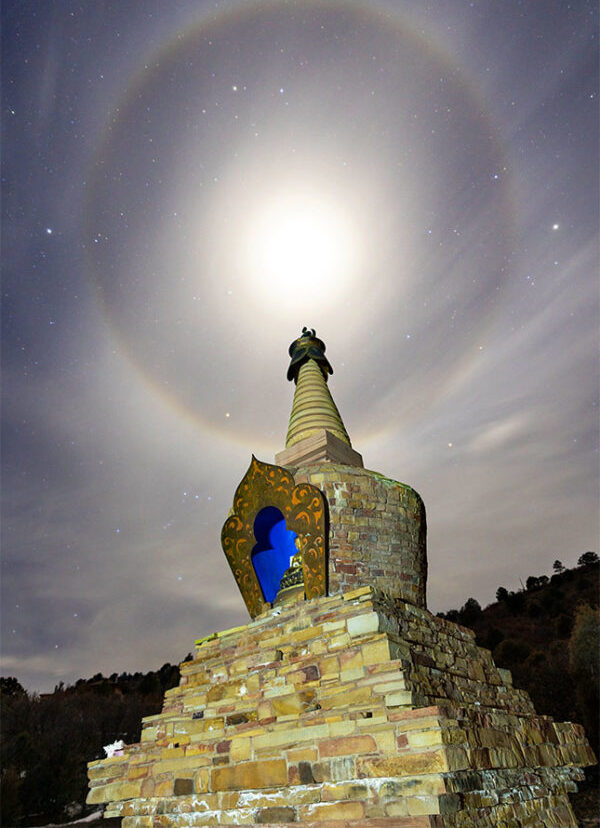
In 1999, Namkhai Norbu Rinpoche, a highly respected Dzogchen master who held Dzinpa Rangdröl through the yogini Ayu Khandro, consecrated the completed stupa. He offered relics of Nyala Pema Duddul and other masters to be sealed inside. The stupa became a tangible anchor for the lineage, even before the full practice cycle was taught at Tara Mandala.

Recognitions That Linked Machig And Dzogchen
A key turning point came in 2007 and 2008.
In June 2007, at Zangri Khangmar, Machig Labdrön’s seat in Tibet, Karma Dorje Rinpoche recognized Lama Tsultrim as an emanation of Machig. He offered her relics of Machig and affirmed her deep connection to the lineage.
Soon after, in Nepal, Lama Tsering Wangdu Rinpoche, the main holder of Machig’s lineage from Tingri Langkhor, independently confirmed this recognition. Three days before Lama Tsultrim’s group arrived, he dreamed of Machig surrounded by her lineages saying, “I will be there in three days.” When they met, he saw Machig above Lama Tsultrim’s head dissolving into her heart and later wrote a recognition letter, long life prayer, and praise to strengthen her vajra pride, the healthy confidence in one’s role as lineage holder.
In the summer of 2008, during a Bardo retreat at Tara Mandala, Lama Tsultrim asked Tulku Sang‑ngag Rinpoche whether there was any connection between Machig Labdrön and Dzogchen, since Machig is usually associated with Mahamudra. Tulku Sang‑ngag replied that Machig had deep connections with Dzogchen. He explained that her first teacher, Drapa Ngoshe, was a tertön who gave her Dzogchen transmissions.
He then told her about the Dzinpa Rangdröl terma, explaining that it:
- Is centered on Machig Labdrön, Dampa Sangye, and Dzogchen
- Forms a complete path from preliminary practices through the highest Dzogchen instructions
- Includes Chöd, Ngöndro, deity practices, the Six Yogas, Trekchö, and Tögal
For Lama Tsultrim, this brought together the two practice streams she had followed for decades, the lineage of Machig and Dzogchen teachings. It also answered her ongoing question of how to establish a Machig practice lineage at Tara Mandala, given her extensive Dzogchen background.
Formal Transmission And Entrustment Of The Cycle
After hearing about the Dzinpa Rangdröl connection, Lama Tsultrim gathered auspicious offerings and formally requested that Tulku Sang‑ngag Rinpoche teach the complete cycle at Tara Mandala. He agreed with joy.
Tulku Sang‑ngag had received the Dzinpa Rangdröl transmission twice from Dilgo Khyentse Rinpoche in Bhutan and Nepal. Although he had transmitted one Chöd practice from the cycle to his nuns in a three-year retreat, he had never taught the full cycle and felt that Tara Mandala would be the place to do so.
In November 2010, Lama Tsultrim and her son, Dorje Gyaltsab Tulku Ösel Dorje, traveled to Dartsedo, or Kangding, in eastern Tibet to meet Do Dasel Wangmo Rinpoche.
Do Dasel Wangmo:
- Was the great granddaughter of Do Khyentse Yeshe Dorje
- Held both the family lineage and the student lineage of Do Khyentse
- Was an ordained nun, respected Tibetan doctor, and tertön
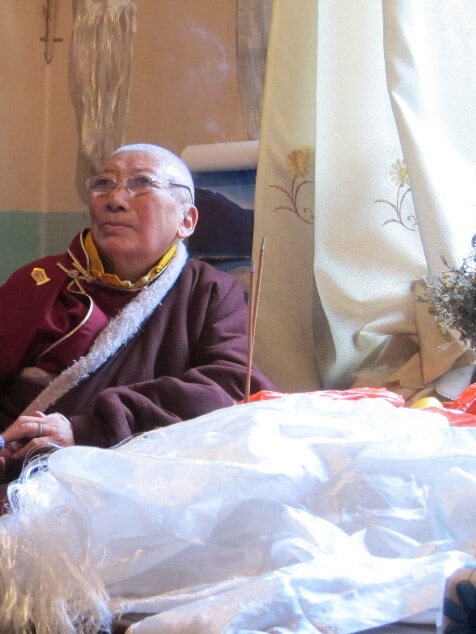 Do Dasel Wangmo taking a pulse
She spent summers at Dzogchen Monastery and winters in Dartsedo, where she served as doctor at a Tibetan college until her passing in 2018. As a tertön, or treasure revealer of hidden teachings, she received many termas from the warrior king Gesar of Ling in childhood, though she burned most of them, saying there were already enough treasure teachings in the world.
During this visit, Do Dasel Wangmo bestowed the Entrustment Ceremony, or katey in Tibetan, for all of Do Khyentse’s termas, the entire Tug Tig collection including Dzinpa Rangdröl, on Lama Tsultrim and Dorje Gyaltsab Tulku. Entrustment is a formal transmission that authorizes someone to hold and pass on a cycle of teachings. She had given this ceremony only a few times in her life.
The ceremony took place on November 23, 2010, in her small apartment at the Sichuan Tibetan School. Senior lamas have said that simply being in her presence is enough to receive blessings.
Through these interwoven events, the lineage took root at Tara Mandala. Nyala Pema Duddul’s dreams and the stupa established the physical seat. Namkhai Norbu’s consecration deepened the connection. The recognition of Lama Tsultrim as Machig’s emanation and Tulku Sang‑ngag’s commitment to teach the full cycle brought the teachings into active transmission. Do Dasel Wangmo’s rare entrustment sealed the link back to Do Khyentse’s family and disciple lineages.
Together, they have made Dzinpa Rangdröl a firmly rooted, living path at Tara Mandala.

How This Lineage Meets Modern Emotional Suffering
Dzinpa Rangdröl is a uniquely profound path for working directly with the movements of human emotion and clinging. It speaks to people who feel stuck in repeating patterns, overwhelmed by stress or trauma, or unsure how to bridge personal healing and spiritual awakening.
It offers a complete path for transforming clinging and fear into a life that is less driven by reactivity and more grounded in compassion and clarity of heart, rather than bypassing or suppressing difficult experiences.
Many practitioners today describe feeling:
- Caught in the same relational or inner loops
- Burned out by constant self-improvement efforts
- Wary of spiritual paths that appear to skip over real pain
This lineage meets those realities directly. Its core insight is that clinging can soften and release when it is clearly seen within a more open, steady inner space, instead of being pushed away or acted out.
Rather than adding more techniques for improving or controlling ourselves, Dzinpa Rangdröl shows how what we resist can become a doorway to a different way of living. Practices invite you to turn toward fear, grief, shame, and anger with curiosity and compassion, discovering that defensive strategies are not the only option.
This approach connects closely with Feeding Your Demons®, Tara Mandala’s contemporary method based on Machig Labdrön’s teaching of “feeding rather than fighting” inner demons. In this work, people engage structured dialogues with inner figures that represent difficult emotions or patterns. Early research suggests meaningful reductions in stress and anxiety, indicating that these principles can support both psychological integration and spiritual growth.
The lineage also carries a rare stream of feminine spiritual authority. It flows:
- From Machig Labdrön, as founder of Chöd
- Through her daughter and later incarnations such as Lösel Drölma and Do Dasel Wangmo
- To Lama Tsultrim Allione, recognized as an emanation of Machig
For many women and non‑binary practitioners, this offers a felt sense of representation and belonging at the heart of the tradition.
For those drawn to Dzogchen, Dzinpa Rangdröl provides a coherent path from foundational practices through Trekchö and Tögal, so advanced instructions are grounded in emotional maturity and ethical stability. For those drawn to Chöd and “meeting what we fear,” it adds a deep understanding of mind that clarifies and completes that work.
These teachings have traditionally been transmitted with care because they are powerful and subtle. Even so, the underlying principles, that resistance can soften when it is fully met, and that what we fear can become an ally when we learn to offer rather than defend, are relevant at every stage of practice and everyday life.
How Does Machig Labdrön Shape This Lineage?
Machig Labdrön is the origin point of this lineage. Her way of meeting fear, clinging, and marginalization with radical compassion defines the spirit of Dzinpa Rangdröl and the practices now held at Tara Mandala.
Early Life And Realization
Machig was an 11th century Tibetan yogini who changed Buddhist practice across all schools at a time when most recognized masters were Indian men. Stories describe her as being born with the syllable AH on her forehead. By age eight she could recite Prajnaparamita texts, teachings on the Perfection of Wisdom that point to seeing reality clearly beyond fear and fixation, from memory.
Around age twenty, her teacher Kyotön Sonam Lama urged her to move beyond concept and recitation. While reciting a chapter on demons, she realized that these “demons” were not external enemies but expressions of fear, grasping, and confusion in the mind. This direct insight cut through ego fixation and launched a new phase of her path.
She then chose a radically unconventional life. Machig left comfort and status, wore beggar’s clothes, associated with people on the margins, and wandered without fixed plans. Practice for her was not separate from everyday life; it took place in the very middle of its messiness and challenge.
Feeding Rather Than Fighting
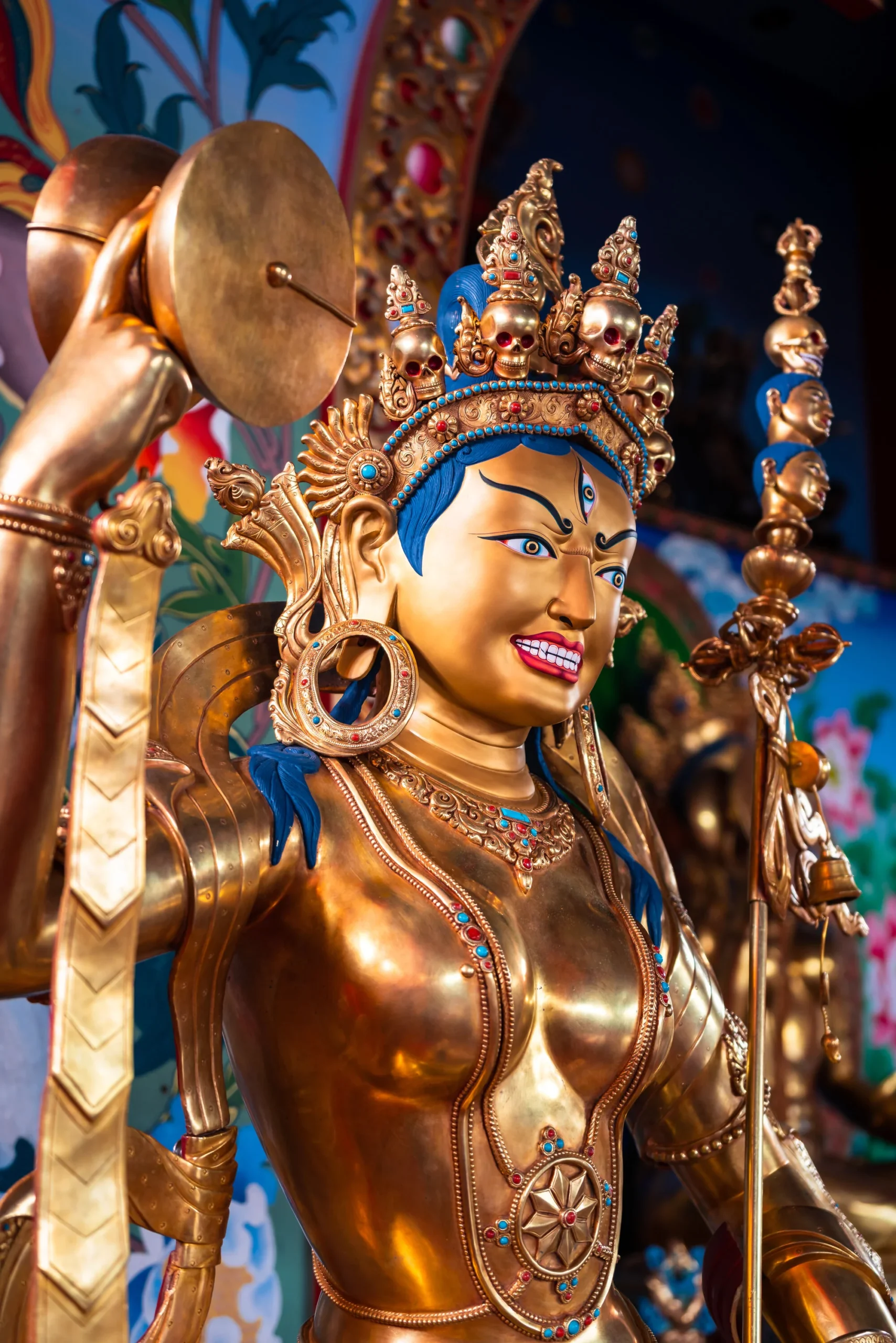
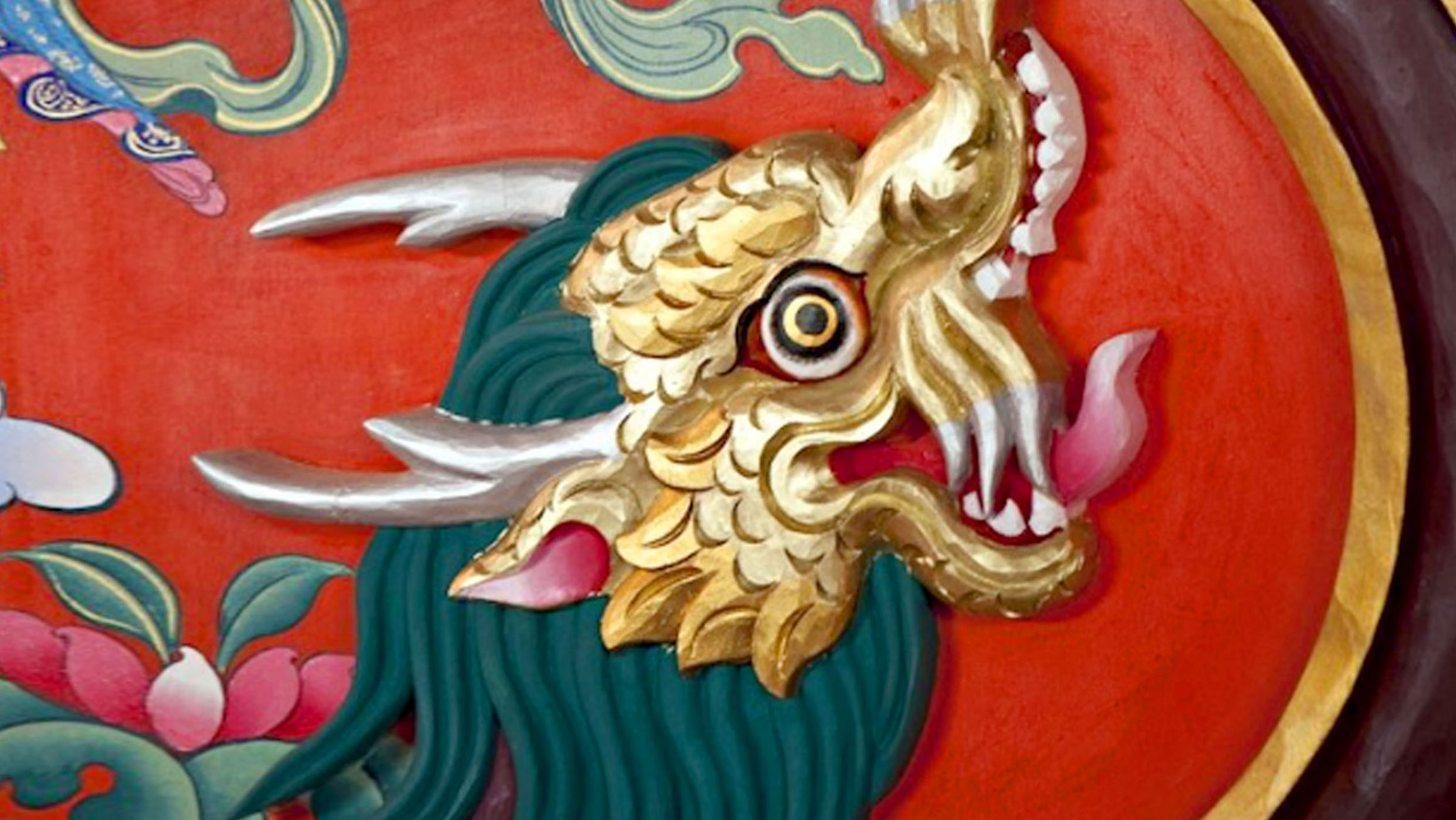
A defining story from this period continues to shape the lineage. During an empowerment, Machig entered deep meditative absorption and, in vision, found herself sitting in a tree above a lake ruled by a fierce naga king, a powerful water spirit. The naga, enraged by her presence, raised an army to attack.
Instead of defending herself or fleeing, Machig offered her own body as nourishment. The attackers were stunned and pledged to protect her. This story of “feeding rather than fighting” expresses a core
principle of her path: what we fear can transform when we meet it with generosity and presence instead of resistance.
That same principle underlies Feeding Your Demons®. In this approach, people meet inner “demons” such as fear, shame, or addiction with curiosity and compassion, discovering that these energies can soften and change when they are seen and fed rather than suppressed.
Practice, Family, And Feminine Wisdom
Machig’s meeting with the Indian master Dampa Sangye further shaped her teachings. He is said to have come to Tibet specifically to find her, recognizing the benefit she would bring to beings. From their exchange, she formalized Mahamudra Chöd, a meditation method that:
- Faces fear, loss, and attachment directly
- Uses visualization and offering to loosen ego grasping
- Cultivates compassion for all beings, including those we usually reject
Her outer life included motherhood and poverty as well as renunciation. At twenty-four she had the first of three children with the Indian yogin Töpa Bhadra. After being celebrated for spiritual realization, she was shunned for becoming a mother, and the family wandered in hardship for years. Later she left her partner and eventually founded Zangri Khangmar, the Red House of Copper Mountain, which became the seat of her teaching.
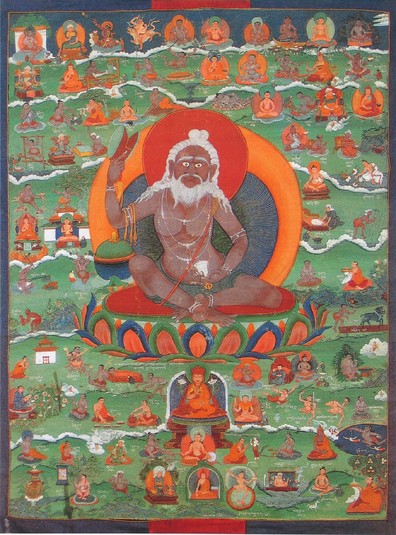
During her early years there, she had a pivotal vision. Tara, the deity of compassionate action, appeared with a host of dakinis, awakened feminine energies that often appear in dreams and visions. When Machig described herself as a foolish woman, Tara revealed that she was a mind emanation of Prajnaparamita, the Great Mother of Wisdom.
This vision:
- Confirmed her authority as a teacher
- Rooted her lineage in the union of emptiness and compassion
- Established a direct line from Prajnaparamita through Tara to Machig as human guide

Legacy Into Dzinpa Rangdröl
As her reputation spread, three Indian scholars traveled to test her understanding. In a large public debate, Machig demonstrated her realization and even revealed her past lives. Recognized as a fully realized teacher and lineage founder, she was invited to teach in India but chose to keep her lineage rooted in Tibet.
She is said to have lived to ninety nine, passing into the dakini realms and leaving behind a living transmission. Her daughter, Ladu Dorje Dronma, was prophesied to be reborn as Lösel Drölma, who became:
- Consort and dharma custodian of Do Khyentse Yeshe Dorje
- A key link in the transmission of the Dzinpa Rangdröl terma
Through these connections, Prajnaparamita to Tara, Tara to Machig, and Machig to her descendants and reincarnations, the qualities of
her path flow directly into Dzinpa Rangdröl. Whenever practitioners at Tara Mandala work with fear, clinging, and marginalization by turning toward them with compassion instead of resistance, they are practicing in Machig’s stream.
How Was The Hidden Teaching Of Dzinpa Rangdröl Revealed?
Dzinpa Rangdröl emerged through three visionary experiences given to Do Khyentse Yeshe Dorje, a 19th century master recognized as the mind incarnation of Jigme Lingpa. In these visions, Machig Labdrön entrusted him with a complete cycle of teachings that unifies her Chöd with Dzogchen and related practices.
Why Is Do Khyentse Essential To This Lineage?
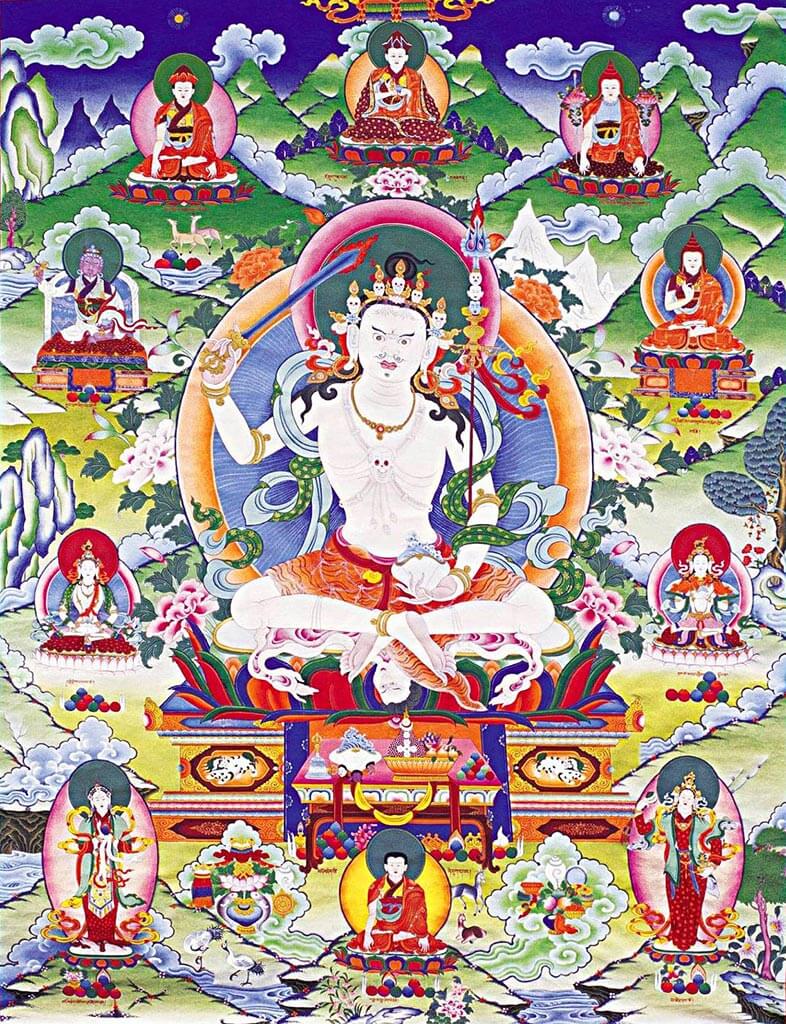
Do Khyentse Yeshe Dorje, who lived from 1800 to 1866, was a tertön, a treasure revealer who uncovers teachings hidden for future generations. He was widely regarded as one of the greatest tantric masters of his era, known for deep realization and many accounts of miraculous activity.
During Jigme Lingpa’s life, students requested Chöd teachings from him. Jigme Lingpa prophesied that a later incarnation named Yeshe Dorje would reveal a more compact collection of termas focused on Chöd. This prophecy was fulfilled in Do Khyentse and his eight volume Tug Tig collection, with Dzinpa Rangdröl at the center.
Do Khyentse did not only reveal texts. He also lived in ways that
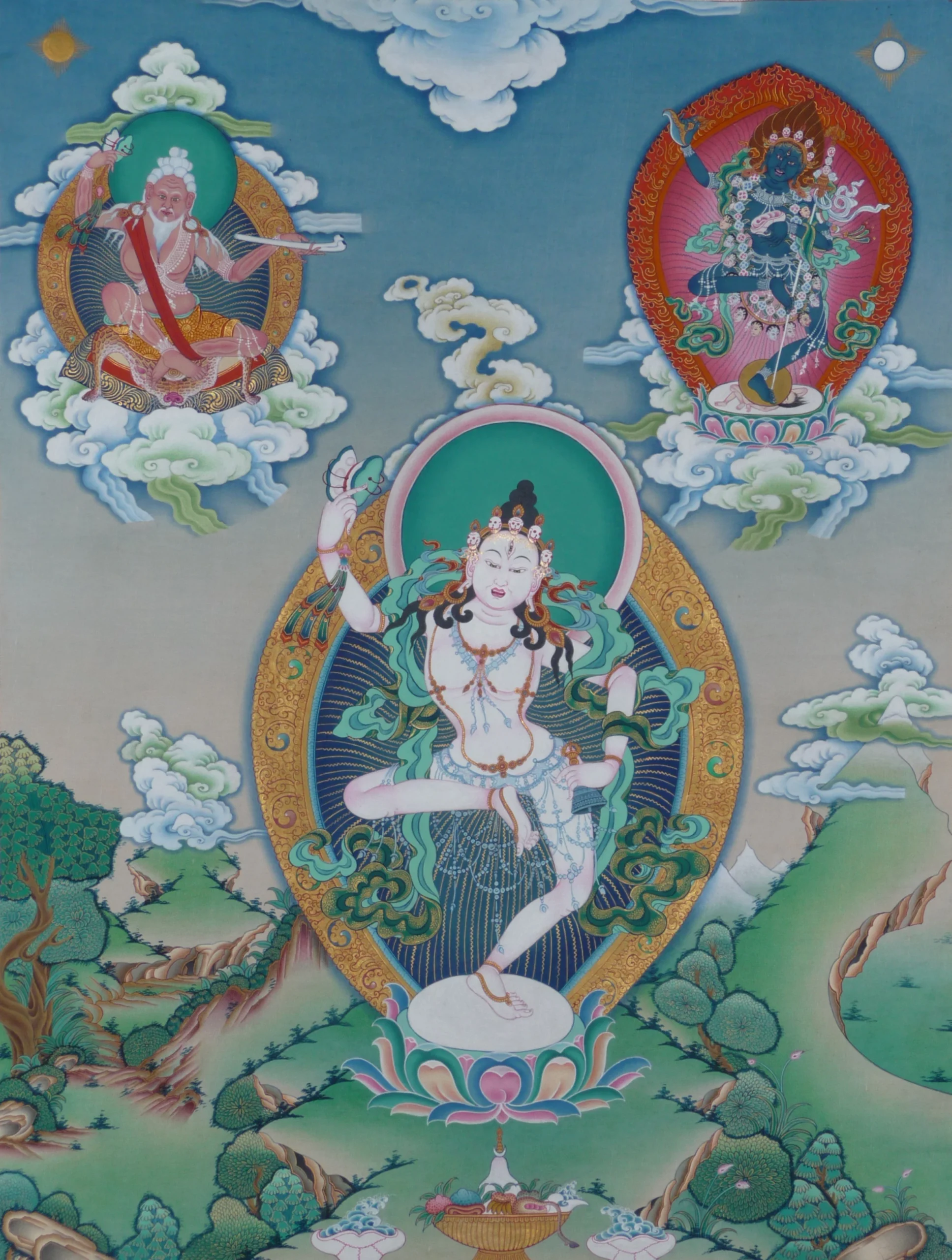
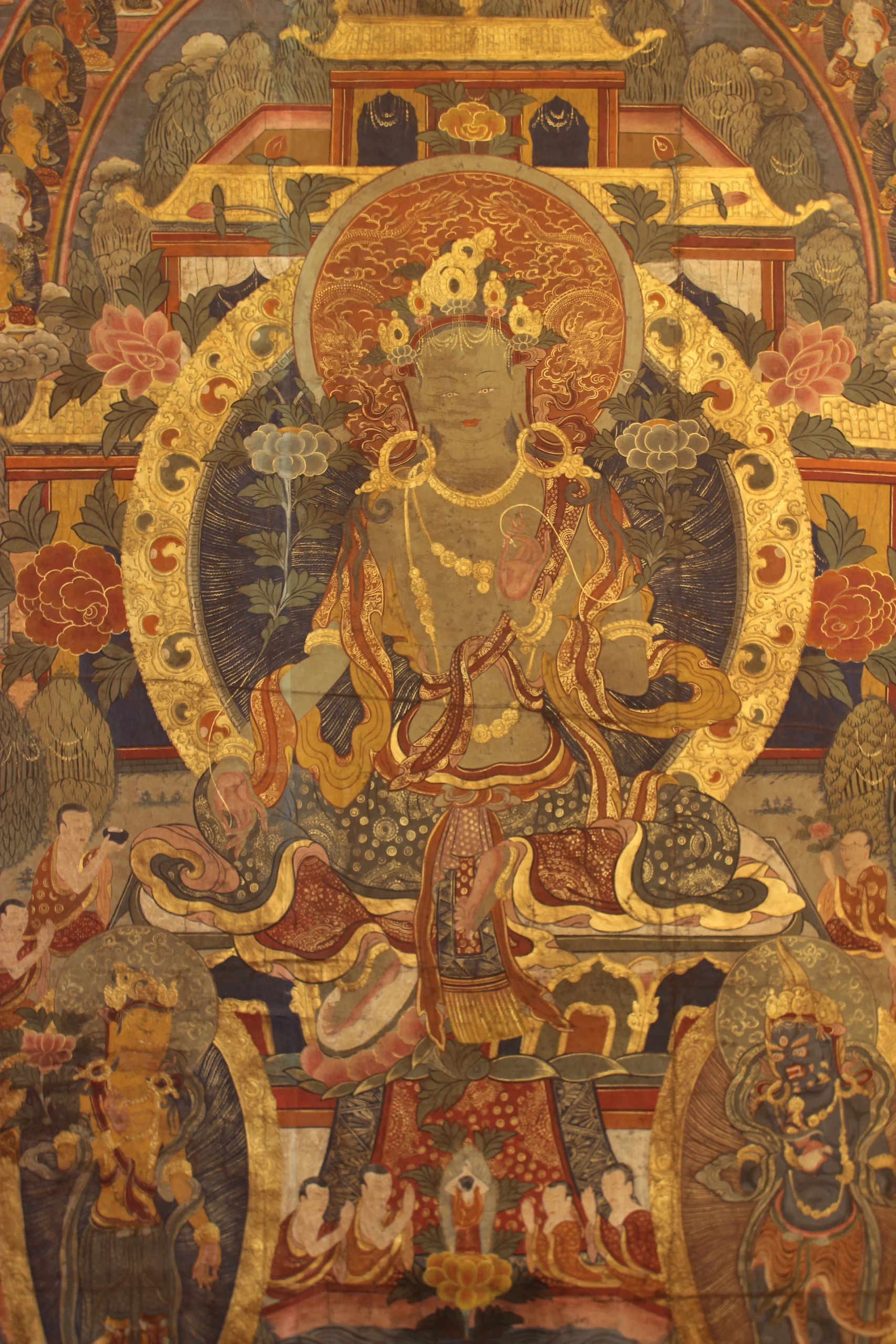
 Do Khyentse Lineage Thangka
challenged ordinary ideas of spiritual life, moving freely between remote retreat, visionary experience, and close connection with students and patrons. This blend of visionary depth and practical transmission shaped how Dzinpa Rangdröl would later be practiced and passed down.
The Three Visions That Revealed The Terma
The first vision unfolded when Do Khyentse visited Zangri Karmar, Machig’s seat in Tibet. In a dream there:
- Two red figures on red horses appeared and told him he was Töpa Bhadra, Machig’s consort
- They identified themselves as forms of Dampa Sangye
- A white woman riding a white bear appeared in the sky and said that although the teaching was not yet revealed, a clear sign would come
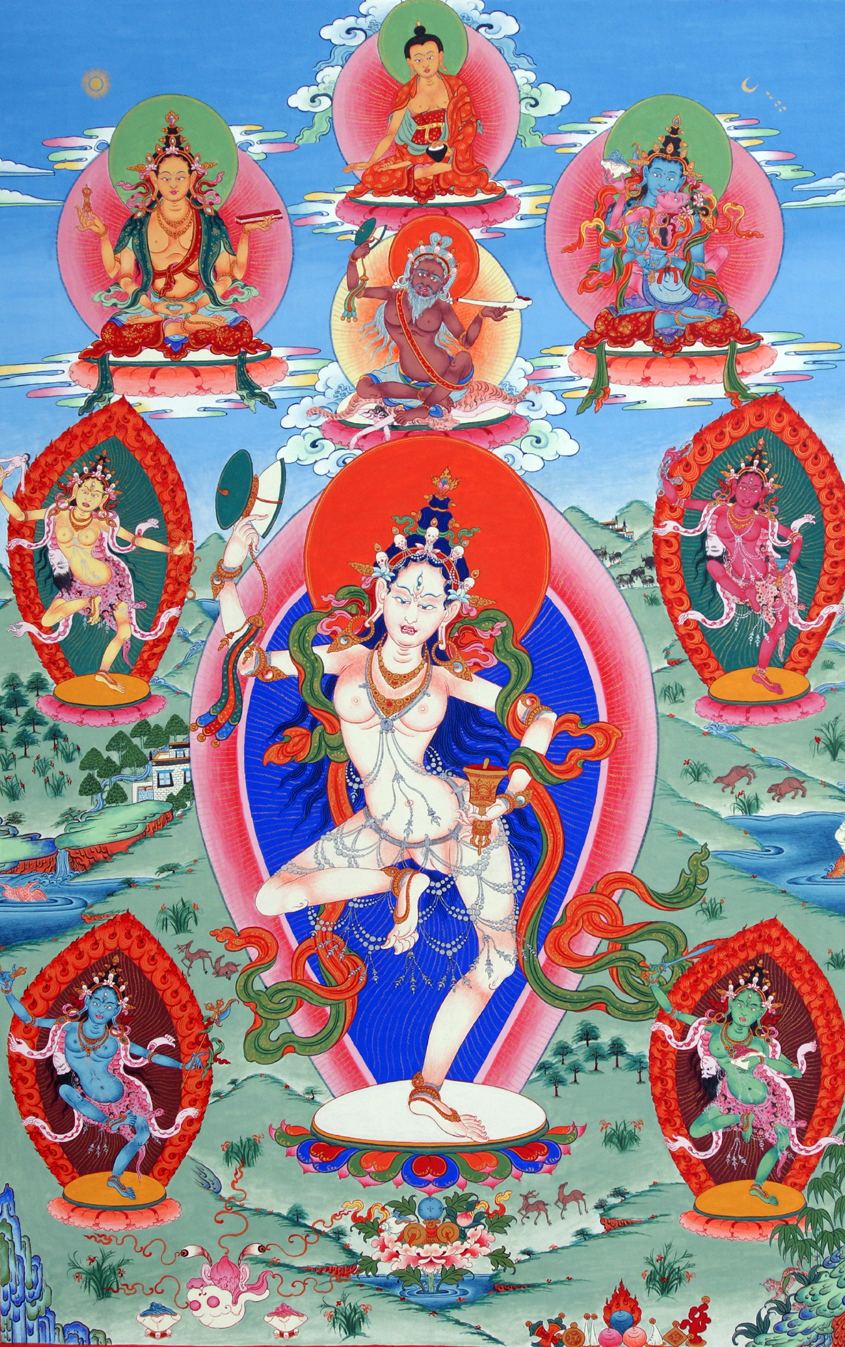
The second vision took place in 1832, on a dakini day at dawn. Within an expanse of rainbow light, Machig Labdrön appeared in the sky surrounded by five dakinis and many male and female yogins. She explained how Prajnaparamita, Madhyamika philosophy, Mahamudra, and Dzogchen form a single, integrated path and described Chöd as a profound way of cutting through obstacles by uniting wisdom and compassion.
In this vision she also performed an entrustment ceremony, where she:
- Offered Do Khyentse a skullcup of amrita, the nectar of realization
- Gave him a glass mirror decorated with rainbows
- Showed him pages from texts containing extensive oral instructions
She told him that all empowerments, transmissions, and teachings were now complete in his mindstream and encouraged him to hold them for future disciples. When he awoke, his room was filled with fragrance and rainbow colors were said to shine from all directions.
The third vision came later in Lutang. There, the mind terma of Dzinpa Rangdröl was fully revealed. Do Khyentse’s close student and scribe, Dechen Özer, wrote down the teachings. With this, the cycle moved from pure vision into a structured path that could be practiced and transmitted.
What Does The Dzinpa Rangdröl Cycle Include?
Dzinpa Rangdröl is a complete path. It contains:
- Ngöndro, foundational practices that prepare body, speech, and mind
- White Dakini and Tröma deity practices
- The Six Yogas, advanced methods for working with subtle energy and mind
- Several Chöd practices
- Full Dzogchen instructions, including Trekchö and Tögal
Short pith instructions that point directly to the nature of mind run throughout the cycle. Because of its depth and power, this lineage has been held quietly and transmitted only to students with proper preparation and connection. Traditional accounts say that practitioners who fully complete this path may attain rainbow body, the dissolution of the physical form into light at death.
Do Khyentse’s consort and dharma custodian was his younger half sister, Lösel Drölma, who lived from 1802 to 1862 and was recognized as the reincarnation of Machig’s daughter. Their son, Dechen Rigpa’i Raltri, received the complete Dzinpa Rangdröl transmission and passed it down through both family and disciples. Those streams eventually converge with the transmissions given to Lama Tsultrim and Dorje Gyaltsab Tulku, forming part of the living lineage at Tara Mandala today.
What Is The Significance Of This As A Women’s Lineage?
This lineage carries a rare, continuous stream of feminine spiritual authority within Tibetan Buddhism. It moves from Machig Labdrön through her daughter Ladu Dorje Dronma, to Lösel Drölma, the reincarnation of Machig’s daughter and consort and custodian to Do Khyentse, to Do Dasel Wangmo, and now to Lama Tsultrim Allione, recognized as an emanation of Machig.
Key features of this women’s lineage include:
- Embodied realization: These women held deep contemplative insight while also navigating family life, community responsibilities, and leadership.
- Relational and compassionate wisdom: The lineage emphasizes meeting others and oneself with courage, tenderness, and clear boundaries, rather than using spirituality to avoid difficulty.
- Integration of practice and everyday life: Motherhood, illness, poverty, and community leadership are not seen as obstacles to awakening but as part of the path.
Lama Tsultrim continues this stream in a distinctly contemporary way, she:
- Brings Machig’s teachings into dialogue with modern psychology through methods such as Feeding Your Demons®
- Holds both traditional lineage recognition and decades of Dzogchen training
- Has founded Tara Mandala as a practice environment where women, non‑binary practitioners, and practitioners of all genders can see themselves reflected at the heart of the lineage
For many students, this women’s lineage offers not only inspiration but a concrete example that profound realization and fully human life can coexist.
How Is This Lineage A Living Transmission At Tara Mandala?
At Tara Mandala, the Dzinpa Rangdröl lineage is not only preserved in texts or stories. It is transmitted through living teachers, embodied practice, sacred places, and the ongoing journey of students. Here, lineage means a stream of understanding and blessing that continues to move through people and place.
Tulku Sang‑ngag Rinpoche carries the Dzinpa Rangdröl teaching lineage. He received the cycle from Dilgo Khyentse Rinpoche, one of the last great masters to complete full traditional training and extended retreat in Tibet before the diaspora. Dilgo Khyentse
received it from Khen Sönam Chöpel, who in turn received it from earlier masters in an unbroken chain back to Do Khyentse’s students.
The family lineage flows through Do Khyentse’s son, Rigpa’i Raltri, to his descendants, including Do Dasel Wangmo Rinpoche, the last living blood lineage holder. When she granted the Entrustment Ceremony for the Tug Tig to Lama Tsultrim and Dorje Gyaltsab Tulku, these teaching and family streams converged in a single line of transmission.
The physical environment of Tara Mandala also participates in this transmission. The stupa built at Nyala Pema Duddul’s request, and consecrated by Namkhai Norbu Rinpoche with relics of great masters, stands as:
- A container for the blessings of the lineage
- A visible focal point for practice and pilgrimage
- A reminder that realization can be embodied in place as well as in people
The land itself has been shaped by decades of retreat, ritual, and daily practice. Many practitioners report that simply arriving at Tara Mandala feels different, as if the environment itself supports introspection and awakening.
Transmission continues through:
- Formal empowerments and oral teachings
- Retreats in which students practice Chöd, Feeding Your Demons®, and related methods
- Longer term training paths that gradually introduce Dzinpa Rangdröl according to each person’s readiness
- Mentoring relationships and peer community, where teachings are tested in real situations
In this way, the Dzinpa Rangdröl lineage at Tara Mandala remains what it has always been, a living path of meeting experience fully, transforming clinging into wisdom, and discovering a more open and compassionate way of being in the world.